


Open your access logs. Count the requests that say Googlebot. Then check how many of them came from Google.
I did that on five of my own sites. Over 30 days, 6,708 requests claimed to be Googlebot. 3,751 of them were fake. That's 56%.
Then I sent the same Googlebot string to the home pages of 100 well-known sites. 59 let it in and 41 turned it away.
The string says who is asking. Only the IP address can prove it.
A user agent string is a claim anyone can make
Google's crawler documentation says it plainly: "The HTTP user agent string can be spoofed."
Scrapers copy it because many sites wave Googlebot past rules that stop everyone else. Rate limits, paywalls and challenge pages all get skipped. Vulnerability scanners copy it too.
In late October, Gary Illyes of Google blamed AI for more bot impersonation (opens in a new tab).
Other counts differ, mostly because the samples and years do. In 2014, Imperva found (opens in a new tab) that over 4% of bots using Googlebot's user agent were impostors.
On one new site in June 2026, Duane Forrester found (opens in a new tab) that only 107 of 799 requests carrying the Googlebot name came from a verified Google address.
A fake share from one site tells you about that site. It's not a benchmark.
How much of the Googlebot in my logs is fake
The sample is five of my own sites, October 5 to November 3, 2026. I tested every request that claimed to be Googlebot against Google's IP ranges and reverse DNS in Server Log Monitoring.
Every claim settled as verified or fake. Google publishes its ranges, so none stayed unverified. The spread between sites is wide.
| Site | Claimed Googlebot | Fake | Fake share |
|---|---|---|---|
www.techseovitals.cz | 346 | 29 | 8% |
docs.vitalsentinel.com | 1,157 | 493 | 43% |
www.technickeseo.sk | 1,282 | 613 | 48% |
www.vitalsentinel.com | 1,943 | 994 | 51% |
www.techseovitals.com | 1,980 | 1,622 | 82% |
| All five | 6,708 | 3,751 | 56% |
Over an earlier window, one of my sites got its fake Googlebot in bursts, not as a steady trickle.
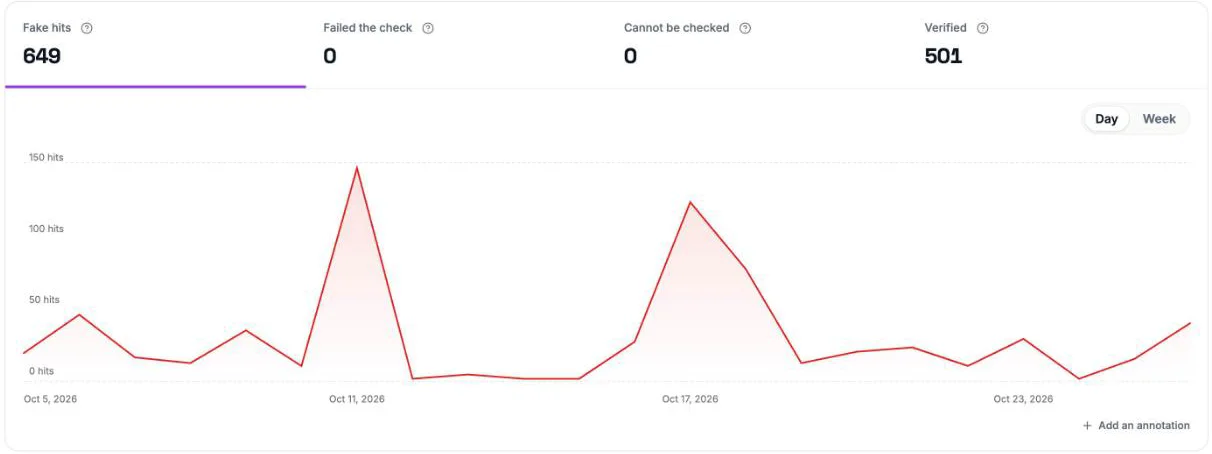 One of my sites over an earlier window: 649 of 1,150 hits claiming to be Googlebot were fake, with spikes around October 11 and 17.
Fake Googlebot is probing for weak spots. On one site it asked for paths like /.env, /userfiles and /api/proc/self/environ. Verified Googlebot got a 2xx on 95% of its 2,957 requests. Fake Googlebot got a 4xx on 89% of its 3,751.
That's a common attack pattern. Automated bots walk through sites looking for exposed config files and known holes, mostly with malicious intent: leaked passwords, API keys, a way in. Posing as Googlebot gets them past rules that would stop an unknown bot.
83% of the fake hits came from one network, AS396982. That's Google Cloud, where anyone can rent an address. On two of my sites that network was labeled Google LLC. A label names who owns the block, not who sent the request.
Verify one address with reverse and forward DNS
Google documents two ways to check a request, in Verify requests from Google crawlers (opens in a new tab). Reverse and forward DNS is the manual one, and Google says it "is sufficient for most use cases."
Take an IP from your log and run two lookups.
host 66.249.66.1
# 1.66.249.66.in-addr.arpa domain name pointer crawl-66-249-66-1.googlebot.com.

host crawl-66-249-66-1.googlebot.com
# crawl-66-249-66-1.googlebot.com has address 66.249.66.1
A real Googlebot address passes two checks:
- The reverse lookup returns a name ending in
googlebot.com,google.comorgoogleusercontent.com. - The forward lookup of that name returns the address you started with.
Whoever controls an IP block controls its reverse records. The forward lookup closes the loop.
The hostname depends on the crawler type. Googlebot resolves to crawl-***.googlebot.com or geo-crawl-***.geo.googlebot.com. AdsBot resolves to rate-limited-proxy-***.google.com. User-triggered fetchers resolve to ***.gae.googleusercontent.com or google-proxy-***.google.com.
I'm stricter on googleusercontent.com. It covers more than crawlers, so I also check the range files.
Verify a whole log with Google's IP range files
DNS works for one address. A log has thousands, so match them against Google's published IP ranges. Google now splits the files by crawler type: common-crawlers.json (opens in a new tab), special-crawlers.json (opens in a new tab), user-triggered-fetchers.json (opens in a new tab), user-triggered-fetchers-google.json (opens in a new tab) and user-triggered-agents.json (opens in a new tab). Googlebot is in common-crawlers.json. Many guides still link the old googlebot.json. It matched common-crawlers.json when I checked, but use the new files.
The ranges change, so don't paste a copy into a firewall rule. Match against the live files on a schedule.
To check a whole log without writing code, run it through the free log file analyzer. It lists every bot in the file and flags the fakes, AI crawlers included.
The string says who is asking. Only the IP address can prove it.
Your log stays in this tab. Nothing you paste is uploaded. Up to 20,000 lines or 2 MB.
A browser cannot run the reverse and forward DNS lookup Google documents (opens in a new tab) as the manual check, which “is sufficient for most use cases”. This checks IP ranges only. For one address with DNS use the Googlebot IP checker.
My five sites, 5 Oct–3 Nov 2026: 6,708 claimed, 2,957 verified, 3,751 fake (56%); from 8% on one site to 82% on another.
If you'd rather paste addresses, use the free Googlebot IP checker. It takes up to 20 IPs, matches all five of Google's files and runs the DNS round trip. It checks an address, not a request. Only your logs show whether that address claimed to be Googlebot.
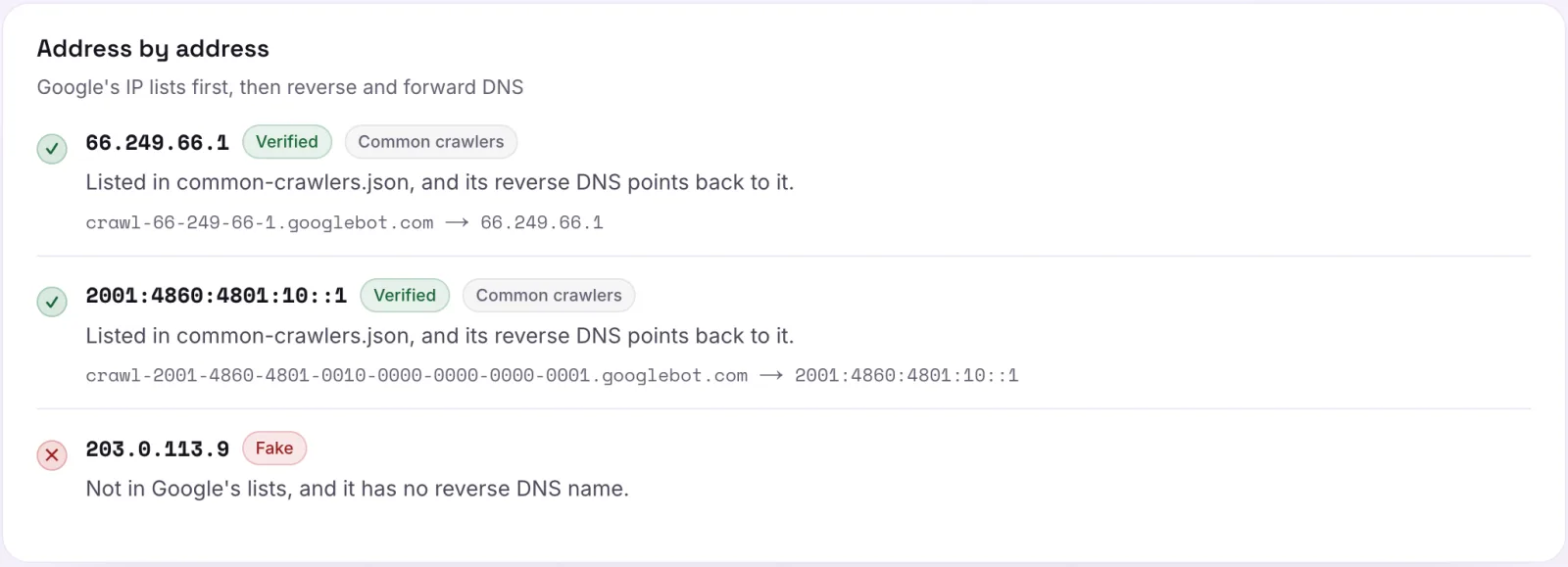 A real Googlebot address names the range file it matched, common-crawlers.json, while a fake one is in no list and has no reverse DNS name.
Googlebot user agent strings, and why matching them isn't enough
Google lists two strings for Googlebot. The version placeholder stands for the Chrome version, and Google says to use wildcards for it when you search logs.
Mozilla/5.0 (Linux; Android 6.0.1; Nexus 5X Build/MMB29P) AppleWebKit/537.36 (KHTML, like Gecko) Chrome/W.X.Y.Z Mobile Safari/537.36 (compatible; Googlebot/2.1; +http://www.google.com/bot.html)

Mozilla/5.0 AppleWebKit/537.36 (KHTML, like Gecko; compatible; Googlebot/2.1; +http://www.google.com/bot.html) Chrome/W.X.Y.Z Safari/537.36
Match Googlebot/2.1 and ignore the Chrome version. That finds every claim in your log, fakes included, because they copy the string character for character. I sent that exact Smartphone string in the 100-site test below.
What 100 sites return to a spoofed Googlebot
On November 3, 2026, I requested the home pages of 100 well-known sites, once each as Chrome, Googlebot Smartphone, GPTBot, ClaudeBot and PerplexityBot. That's 500 requests from one non-Google IP, across eight sectors from e-commerce and news to banks and CDNs.
A site that refuses the Googlebot string from here is doing its job. I'm counting responses, not grading sites.
| Answer to the Googlebot string | Sites |
|---|---|
| 200 or 202 | 59 |
| 403 | 30 |
| Dropped connection | 6 |
| 429 | 3 |
| 401 or 502 | 2 |
Most walls weren't about Googlebot. The plain Chrome string was refused at 32 sites, so those defenses judged more than the user agent. Their firewalls most likely spotted my automated script: one IP sending five user agents in a row. Only nine sites served Chrome and refused Googlebot. Seven of them refused every bot string. Two refused only Googlebot, a rule written for exactly this case.
No site went the other way. None gave the Googlebot string a page the browser didn't get. A home page can't reveal a rate limit or a paywall exemption, though, and that's where trust in the string usually hides.
Ten refusals came from a vendor challenge, like Cloudflare's "Just a moment" page. Every one carried a 403 or 429, not a 200, so status checks see them. The six dropped connections are the quiet case. No status code, nothing for status monitoring to catch.
The costly failure is blocking the real Googlebot. This test can't see it.
Which AI crawlers you can verify, and which you can't
The same idea works for AI crawlers where the vendor publishes a list. OpenAI publishes gptbot.json (opens in a new tab), searchbot.json (opens in a new tab) and chatgpt-user.json (opens in a new tab). Perplexity publishes perplexitybot.json (opens in a new tab) and perplexity-user.json (opens in a new tab). Anthropic links bots.json (opens in a new tab) from its crawler help article (opens in a new tab). You match the address, as you do with Google.
Over the same 30 days, 33,443 requests on the five sites carried the user agent of an AI training crawler. 12% verified, 16% were fake and 73% were unverified, which means the check couldn't settle them.
The cloud blocks that faked Googlebot also claimed to be GPTBot, ClaudeBot and CCBot. On www.vitalsentinel.com that same network used 26 bot names. For 13 of them, I could prove the hits were fake. Rotating user agents is the tell.
In the 100-site test, the AI strings were refused at 40 to 44 sites. Seven sites served the Googlebot string and refused at least one AI string. That reads as policy.
Where a vendor doesn't publish a list, you either trust the string or block it.
Block fakes without blocking the real crawler
Robots.txt is a request. A fake bot doesn't have to honor it. The fakes in my logs asked for /.env, and a disallow line doesn't protect that file.
Block them with a rule that verifies first. A rule on the user agent alone gets bypassed by the bots it targets.
Cloudflare's Managed Ruleset includes Anomaly:Header:User-Agent - Fake Google Bot. It matches the user agent, then verifies the source with reverse DNS or IP validation. Cloudflare's troubleshooting guide for fake bot managed rules (opens in a new tab) warns it can false-positive on Google Cloud services and third-party monitoring tools. The fix is a scoped exception, not switching the rule off.
Don't treat every Google address as fake either. User-triggered fetchers, which Google runs when a person asks for a page, ignore robots.txt, so a Google IP hitting a disallowed URL isn't automatically an impostor. And never serve a JavaScript challenge site-wide.
Then watch the real crawler. Google Search Console's Crawl stats report only counts Google's own fetches. In my logs, verified Googlebot got a 4xx on 2% of requests. If that jumps after a firewall change, a rule just caught the real one.
To see what your own home page serves each string, run this:
for ua in \
  "Mozilla/5.0 (Macintosh; Intel Mac OS X 10_15_7) AppleWebKit/537.36 (KHTML, like Gecko) Chrome/142.0.0.0 Safari/537.36" \
  "Mozilla/5.0 (compatible; Googlebot/2.1; +http://www.google.com/bot.html)"; do
  curl -sS -L --compressed -o /dev/null -A "$ua" -w "%{http_code} %{size_download}\n" https://example.com/
done
Expect the same status and a similar size. A 403 for the Googlebot line is fine from your laptop. A 200 with a much bigger or smaller size means you serve bots something else.
Trust the address, never the string
More than half of the Googlebot on my sites wasn't Google. Most of it came from rented Google Cloud addresses, and it probed paths like /.env instead of reading pages.
Well-known sites mostly get this right. None of the 100 gave the Googlebot string a better page than a browser, and most refusals came from defenses that look past the user agent.
AI crawlers are the open gap. Every Googlebot hit in my logs settled one way or the other. Three in four AI training crawler hits couldn't be settled at all.
So find your own split before you trust any crawl number. Run last month's access log through the free log file analyzer and see how much of your Googlebot is real.
Anyone can type Googlebot. Only Google can send it from Google's addresses.

Written by
Martin Stepanek
Enterprise Technical SEO Consultant
15+ years building enterprise websites and designing the infrastructure behind them, and 5+ in technical SEO and web performance. My work is making companies findable – not just on Google, but inside ChatGPT and the other AI engines people now ask first. I write a regular newsletter and blog on technical SEO at TechSEO Vitals, and I built VitalSentinel because the gap between something breaking and someone noticing should be minutes, not days.
The VitalSentinel Newsletter
New features as they ship and practical technical SEO tips. One email a week at most.
